
What is moonshine?
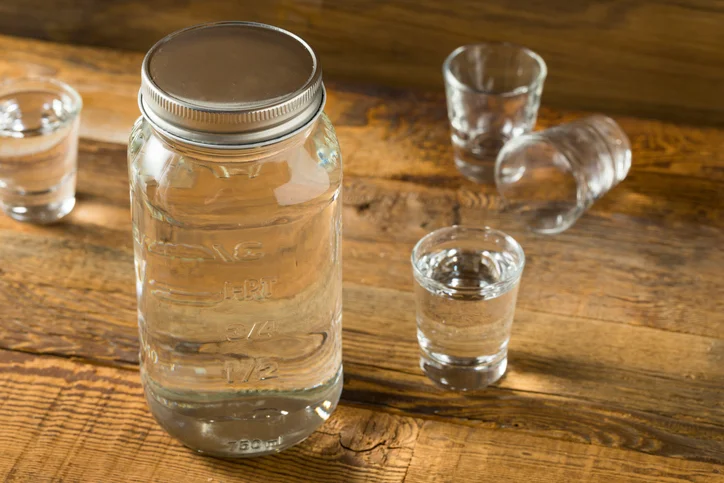
Moonshine is a type of alcohol that has roots in illegal sales and production, but may be legally distilled today depending on location. Improper home distillation may produce methanol, which is dangerous to consume. Modern day moonshine is categorized as unaged whiskey usually with a base of corn.
The original term “moonshine” emerged back in the 15th century, and gained traction to refer to illicit alcohol production in England in the 18th century. At the time, it meant any illegally produced alcohol. The people who made it later became known as “moonshiners” because they ran their stills under the cover of darkness to avoid detection from authorities.
The drink lingered around 18th and 19th century America and has been at the center of several historical events, like the Whiskey Rebellion of 1794, and it indirectly led to the genesis of NASCAR racing. Although the definition of moonshine is shifting to refer to simply clear, high proof whiskey, it continues to have a connection to home distillation.
What is moonshine made out of?
The majority of moonshine is made from corn, but any kind of grain like wheat, rye, or barley may be fermented to produce it. At one point during Prohibition, the demand for moonshine was so high, distillers used sugar as their main ingredient— technically making their moonshine a type of rum.
Traditionally, moonshine is a whiskey that has not been aged in an oak barrel, so it doesn’t have that traditional brown color.
What proof is moonshine?
Moonshine is a high-proof alcohol, with a rough range between 60 to 120 proof. Whatever an alcohol’s “proof” is equates to twice its Alcohol By Volume, or ABV. Moonshine’s typical ABV is 30-60% but may be even higher, especially if consumed straight from the still. For context, beer is typically around 3-8% ABV or 6 to 16 proof, while wine is around 9-15% ABV or 18 to 30 proof.
Does moonshine go bad?
Moonshine typically has a long shelf life, especially if purchased from a reputable source. If stored in a cool environment and out of direct sunlight, it can last for years. It does not need to be refrigerated. When opened, it’s generally recommended to consume it within a year in order to ensure proper quality.
Unflavored moonshine should be clear. If it’s an off-color or has a strange smell or taste, do not consume it.
Is moonshine illegal? Why?
In the United States, federal law strictly prohibits home distillation of spirits. Beer and wine are regarded differently. Moonshine can be dangerous and even fatal if it isn’t distilled properly. Some states do allow for home distillation, but federal law still requires a Federal Distilled Spirits Permit, especially if the distiller is planning to sell or distribute spirits.
Along with safety and quality concerns, regulations ensure the collection of federal excise taxes on distilled spirits. These are otherwise often evaded in illicit moonshine production. The government continues to monitor moonshine production for tax evasion purposes.
Beyond the federal level, a few states have their own legislation on home distillation of moonshine. In Missouri, it is legal to distill a maximum of 200 gallons of moonshine at home per year for your own consumption. You need to be over the age of twenty-one.
Other states like Alaska, Arizona, North Dakota, and Massachusetts also have home distilling legislation that allows for some moonshine production (although North Dakota’s technically still leaves it outlawed).
Does moonshine make you go blind?
If distilled properly, moonshine is unlikely to cause blindness (although it is strong enough to cause alcohol poisoning).
Methanol is a chemical that’s produced during moonshine distillation and is responsible for damaging the optic nerve. As little as a mouthful or two of methanol can produce symptoms and even be fatal.
The distribution of methanol in a batch of moonshine is often concentrated in the first 50-100 milliliters that come out of a still, commonly referred to as the “foreshot.” Methanol along with acetone and other impure alcohols evaporate first. These byproducts condense through the physical still, and are contained in the first liquid released from the still.
So, if someone who is home distilling moonshine isn’t aware of this and consumes moonshine containing the foreshot, there may be serious consequences.
During Prohibition, some moonshiners distributed the foreshot either due to demand or ignorance. When people drank high enough concentrations of methanol, they suffered “moonshine blindness” or even died. That spurred the urban legend that drinking any moonshine could make someone blind, which isn’t the case.
However, that’s enough of a danger to be skeptical of consuming home distilled moonshine from people you don’t trust.
How does methanol make you go blind?
Distilling most alcohols produces methanol, not just moonshine. Methanol is a byproduct of the fermentation process. It is released when pectin, a natural fiber found in fruits and vegetables, is broken down. Corn and most grains are technically fruit and, therefore, produce methanol.
The body can handle a very small amount of methanol, so beverages from reputable sources, like the beer and wine you buy at the store, are typically little cause for concern. The methanol is distributed evenly, and in such small amounts, that the concentration does not reach dangerous levels.
Methanol metabolizes into formaldehyde and then into formic acid in the body. Formic acid inhibits the production of ATP, an important molecule that helps oxygen be used by the body’s tissues. This, in turn, creates “cellular hypoxia” or suffocates the body’s cells. We see a similar process for poisoning with the toxic chemicals in antifreeze.
This impacts the optic nerve quite a bit, damaging it to the point that many methanol toxicity survivors continue to suffer from vision problems.
How to Avoid Moonshine Blindness
- Only consume alcohol from reputable sources
- If distilling at home, properly research and understand the distilling process
- Never consume or serve the foreshot in a batch of moonshine
Other Distillation Mistakes Include:
- Using lead-based products in the still, which may lead to lead poisoning
- Not distilling enough times to remove impurities
- Boiling the alcohol at the incorrect temperature
Symptoms of Methanol Toxicity
- Vomiting
- Drowsiness and confusion
- Abdominal pain
- Seizures
- Coma
- Blurred vision
- “Snowstorm” field of vision
- Partial or complete loss of vision
Have A Question We Didn’t Cover? Call the Missouri Poison Center
If you have questions about methanol, ethanol, moonshine, or anything poison related, call the Missouri Poison Center at 1-800-222-1222. We’re open 24/7 to answer calls quickly and confidentially.
If you or someone you know distills at home and you have questions about safety, call the Missouri Poison Center.
If you or someone you know drank moonshine and is unresponsive or experiencing loss of vision or abdominal pain, call 911 immediately.
Frequently Asked Questions
Cloudiness, strange smells, unusual taste, or off-colors in moonshine can indicate contamination. If any of these are present, do not consume it.
Yes. Flavored moonshine can still contain methanol if improperly distilled. Flavoring does not eliminate the risks associated with methanol.
No. Homemade moonshine that’s not regulated may not meet safety standards and could be contaminated with methanol or other toxins.
Commercial moonshine is produced under strict regulations that monitor methanol levels and overall purity, making it much safer than unregulated home batches.
Seek emergency medical help immediately or call 911. Methanol poisoning is life-threatening and needs rapid treatment to prevent permanent damage or death.
Home testing for methanol is unreliable and potentially dangerous. Some kits exist, but they aren’t foolproof. Only consume alcohol from trusted, regulated sources.
Referencing content from this page? Please attribute the Missouri Poison Center with either of these links:
https://missouripoisoncenter.org/ or https://missouripoisoncenter.org/moonshine/
Suggested APA citation:
Hazelbaker, H.J. (2025, May 18). How safe is moonshine? What you need to know. Missouri Poison Center. https://missouripoisoncenter.org/moonshine/