
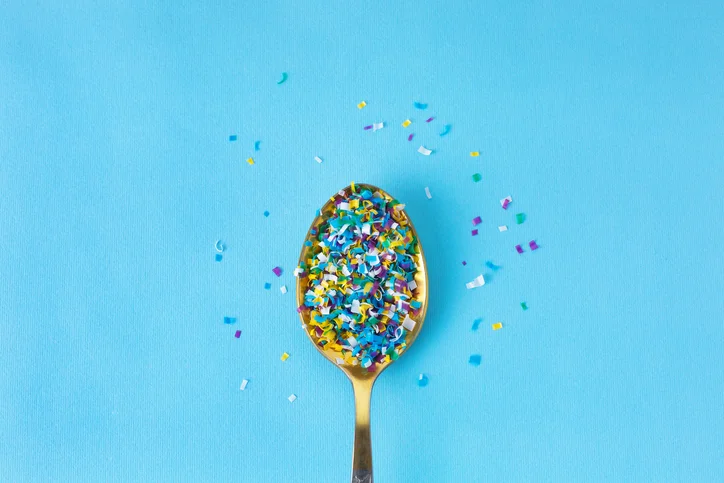
In past blog articles, we’ve discussed trending poison topics that are generally something you may avoid. The BORG, parasite cleanses, and magic mushrooms are all things you don’t have to interact with if you choose not to. That is not the case with microplastics. These tiny particles are everywhere and are quite difficult to avoid encountering. So what do we know for sure, and how do we deal with them? Let’s unpack this and more below.
What are microplastics?
Microplastics are tiny bits of plastic, less than 5 millimeters long. Anything smaller than 1 micrometer is considered a “nanoplastic” and falls into this range. Any type of plastic can create microplastics, meaning there’s a large diversity of plastic types and chemicals in the environment. Microplastics are so small that they’ve found their way into food, water, air, and people. They take many forms, such as pieces, fragments, foams, fibers, or beads.
There are two main types of microplastics: primary and secondary. The primary type is designed to be small, beginning as a tiny plastic product. They did not have to degrade to get to their size. You find these in cosmetics, cleansers, toothpastes, and paint, among others. The secondary type starts as a large plastic and becomes small with time and use. These big plastics degrade or break down and then shed or break into smaller pieces.
Where can you find them?
Their presence is quite ubiquitous in the United States, meaning you can find microplastics anywhere. Head to any beach or riverway, and you may find them in the sand and dirt. As plastic degrades in the home or on roads, it ends up in dust, which we may breathe in. Plants and animals we use as food may take in or consume microplastics over the course of their lives. This accumulates in those plants and animals, and we eventually consume that. The clothes we wear can be made of plastic, which sheds or degrades, releasing plastic fibers into the air and water.
Microplastics have been found in human tissues, including the heart, brain, lymph nodes, placenta, sperm, breastmilk, and blood. Some babies are born already with microplastics in their stool.
Why doesn’t plastic break down the way plants do?
Plastics don’t decompose the way things like plants and natural elements do. This is because there are no microbes or fungi with the ability to easily and effectively “digest” plastic, breaking it down and redistributing the chemicals to the environment. Even though plastic gets smaller, things like bacteria, worms, people, and plants can’t reuse the chemicals in plastic for their own purpose (whereas they could use/redistribute the chemicals in something like an apple). So plastic accumulates. Your body filters out indigestible materials like plastic in your waste.
What is BPA?
BPA stands for Bisphenol-A. It is part of a family of chemicals called the bisphenols, which are all used to make polycarbonate plastics and epoxy resins, including BPF and BPS. BPA is the most controversial because it is the most widely used. You can find it in water bottles, lining metal cans, and many other single-use plastic containers. BPA plastic may leach its chemicals into food if the plastic is heated.
BPA has been linked to things like disrupting the body’s endocrine function, meaning it may interrupt the body’s hormones. While it is banned from being used in baby bottles in the United States, the FDA has reviewed the current research and found the amount of BPA in food to be at a safe level for consumption. The ban on BPA in sippy cups and bottles was the result of a request for a review, as well as a response to a shift in the industry. It was not because the FDA found BPA to be a serious safety concern.
Since BPA is found in many polycarbonate plastics, some microplastics contain it. Microplastics may increase BPA exposure more than bulk plastic, as tiny particles may release chemicals more readily in the gut. Research is underway to find out about this.
Third parties have called for the FDA to review BPA’s safety again, citing research that suggests BPAs could be more prevalent and potentially more harmful than we think. This is definitely a point of controversy.
Are microplastics harmful?
In short, we don’t know the full extent of how microplastics affect our health.
One study on microplastics has gained quite a bit of popularity. It was an observational study that noted that participants who had a higher level of microplastics in plaques removed from their carotid artery were more likely to have a heart attack or stroke later in life than those who didn’t.
Naturally, this raises some alarms about how microplastics affect our health. It’s a preliminary study, but promising enough to spur more research. However, there are a few problems when it comes to studying microplastics. One is that it is difficult to get a microplastic-free group of people (a control group) to help compare and contrast symptoms. Another is that there’s a gap in research between the effects of plastics on humans versus on animal or cellular subjects.
Managing unknown factors is a part of healthcare. There are so many variables that may affect someone’s wellbeing. For example, if someone puts an adhesive bandage on a scraped knee, then breaks out in hives, it may seem reasonable for them to assume that bandages cause hives. However, that person may have an underlying allergy to another substance. The underlying cause was not the bandage, but the allergy. Someone else may use one without any issues.
As diseases like cancer and heart disease become more common, and since microplastics are found everywhere, it may be tempting to assume microplastics are the cause. However, this connection needs to be proven through research. Because microplastics are a relatively new issue, we don’t yet know their long-term health effects. Scientists are still working to understand them.
Of course, doing something feels better than waiting. Reducing microplastics in the environment, no matter how harmful or harmless they are to our health, would ultimately lead to a cleaner, more cared-for world.
What can we do about microplastics?
Ultimately, managing microplastics comes down to managing plastic production and waste. This will need policy changes and government action. Primary microplastics in cosmetics (micro-beads) were banned from being manufactured and sold in the United States in 2017 and 2018, respectively. This decreased the amount of them in certain water supplies. Policies like this may help control the amount of microplastics in the environment, which may help reduce the amounts we find in ourselves.
How to Avoid Microplastics
There are a few ways to reduce your microplastic intake:
- Heating plastic products may cause the chemicals from plastic to seep into food. When microwaving or reheating food, use ceramic or glass containers (like a ceramic bowl or plate).
- Handwash your plastic when possible. The heat from a dishwasher may cause plastic to degrade.
- Replace multiple-use plastic products when they show signs of wear, like bubbling or flaking.
- Do not reuse single-use plastics, like single-use water bottles or food take-out containers.
- Opt for glass, metal, or ceramic containers whenever possible.
- Drink filtered tap water instead of using plastic water bottles.
- Replace plastic cutting boards with wood or bamboo.
- Vacuum and dust indoor spaces regularly to clean the air of microplastics in dust.
Have questions? Call the Missouri Poison Center
There will always be plastic in our life. But small, positive changes will always be better than doing nothing. As new research emerges and we improve our understanding, there will be more effective ways to coexist with the microplastics in our lives.
If you have questions about BPA or microplastics, call the Missouri Poison Center at 1-800-222-1222. We’re open 24 hours a day, 7 days a week to answer any of your poison-related questions. Every call is fast, free, and confidential.
Frequently Asked Questions
BPA-free plastics typically contain other members of the bisphenol family, like BPF or BPS. These chemicals are quite similar to BPA. While research is underway on the effects of these other bisphenols on people, it is hypothesized that they act similarly to BPA. There is no evidence that BPA-free plastic is necessarily “safer” than BPA plastic, which may be misleading to a consumer.
No, silicone does not contain microplastics, as it’s not petroleum-based plastic but a polymer from silica. Food-grade silicone is stable and FDA-safe for food contact. While it may fragment into larger pieces over centuries (not <5mm microplastics), it sheds far less than plastics during use.
Yes, silicone is inherently BPA‑free. Unlike polycarbonate plastics or epoxy resins, silicone rubber does not contain or rely on bisphenol A or related chemicals. Food‑grade silicone that complies with FDA regulations is considered suitable for food contact and is widely viewed as a safer alternative to BPA‑containing plastics.
Yes. Polyester and other synthetic fabrics can release tiny plastic fibers, especially during washing and drying. These fibers can enter wastewater systems and, in some cases, the air inside your home. Using gentler wash cycles, colder water, and filtering devices (like laundry bags or machine filters) may help reduce how many fibers are released.
Referencing content from this page? Please attribute the Missouri Poison Center with either of these links:
https://missouripoisoncenter.org/ or https://missouripoisoncenter.org/microplastics-and-bpa
Suggested APA citation:
Missouri Poison Center Trending Topics Blog. (2026, April 28). Microplastics, BPA, and Our Health: A Summary. Missouri Poison Center. https://missouripoisoncenter.org/microplastics-and-bpa