
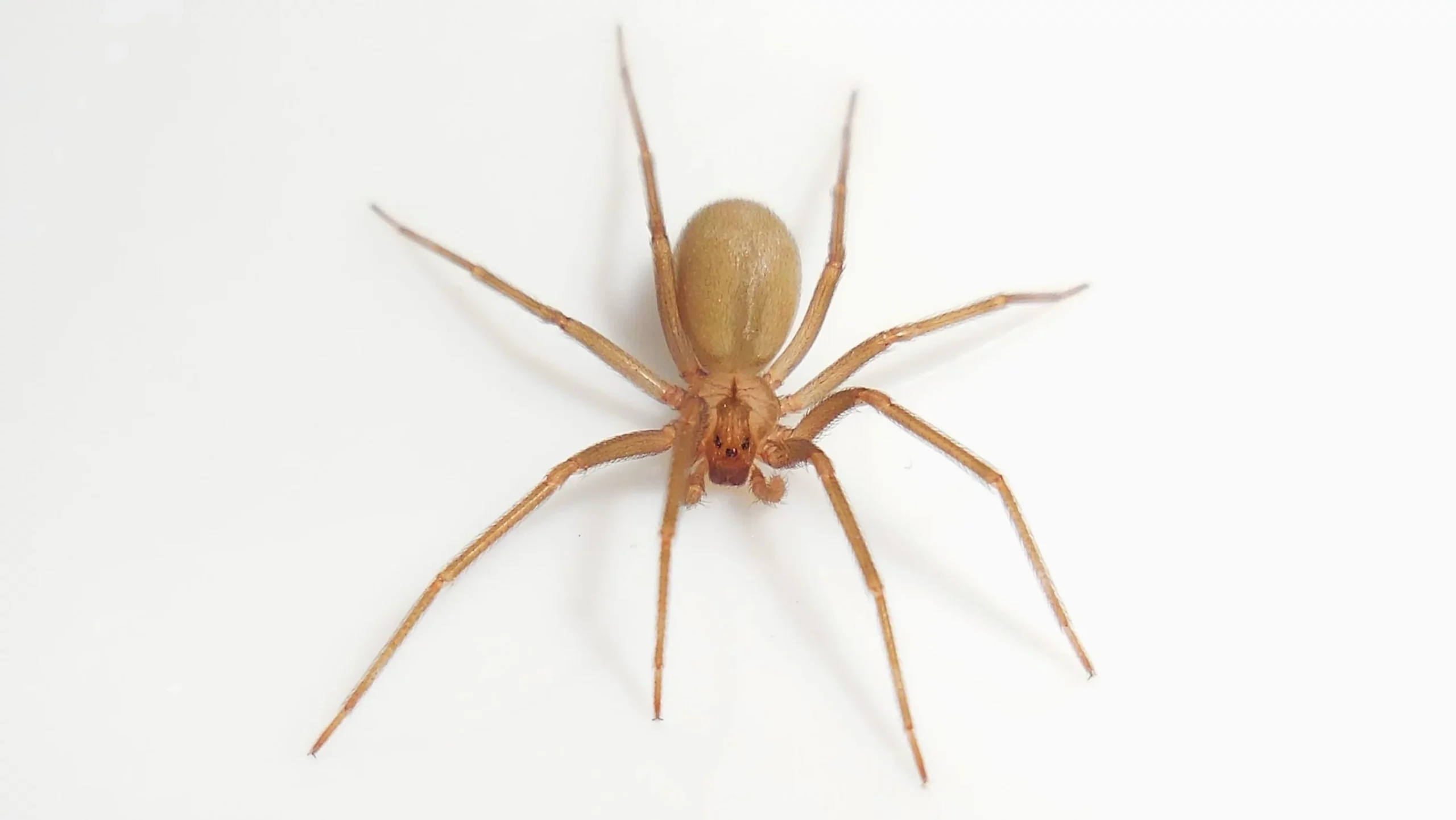
The brown recluse spider, while venomous, is not responsible for as many bites a year as we believe. While any bite or blister should be taken seriously, the hard truth is that sometimes it’s just not a spider bite. And if it is a spider, sometimes it’s just not a brown recluse. And if it is a brown recluse, that doesn’t guarantee a trip to the hospital. Today, let’s examine the brown recluse spider, its doppelgängers, its bite, and when you should seek help if you’ve been bit.
Brown Recluse Spider Facts
What Do They Look Like?
The brown recluse spider, or Loxosceles reclusa, is dark brown to tan in color. It has a violin-shaped marking on its back (or cephalothorax). The violin shape begins at its eyes and ends at its abdomen.
Unfortunately, a few other spider species share the same or similar “fiddle-back” pattern. So, while it’s a good rule of thumb, it’s not a terribly reliable way to identify it.
The best way to tell a recluse apart from other spiders is by looking at its eyes. Many spiders have 8 eyes arranged in twos or fours. The recluse, however, has 6 eyes arranged in 3 pairs: 1 pair in the middle of its head and the other 2 pairs adorning its sides.
Loxosceles in Greek means “with slanting legs,” referring to their thin, dainty legs that slope away from their body. They are not “hairy” like a tarantula or wolf spider, and they don’t have other color patterns besides their violin shape.
How Big Is a Brown Recluse Spider?
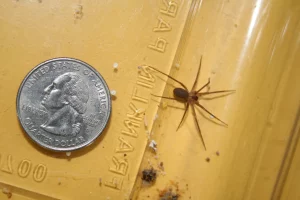 It’s a small creature, measuring at a whopping ¼ to ½ an inch in length (no bigger than a quarter). These spiders prefer their space, but many may reside in a home at a time. There was an incredible case of a home that housed over 2,000 brown recluse spiders during a 6 month period. No one in the house suffered a bite.
Behavior
They’re not named “recluse” without reason; these arachnids do not want to encounter you. These spiders tend to run when you uncover their hiding place. They tuck themselves away into attics, closet corners, cupboards, drawers, behind picture frames, or any untouched area of the home. Clothing and sheets that are seldom moved may attract a brown recluse.
A brown recluse may make a halfhearted web, but these spiders are scavengers— they prefer finding prey that’s already dead over catching live prey in webs. Nocturnal by nature, these spiders emerge at night to search for dead bugs in isolation.
Are Brown Recluse Spiders Poisonous?
While brown recluse spiders are technically venomous, not poisonous, their venom is toxic to humans. The brown recluse carries what’s known as a cytotoxic (or necrotic) venom. Cytotoxic venom leads to tissue necrosis (AKA death of the skin) around the bite. It’s what’s responsible for the scary-looking black scabs infamously associated with the brown recluse.
Where Is the Brown Recluse Spider Found?
In the wild, you may find Loxosceles reclusa under stones, inside bark from decaying trees, in dead leaves, and in other forested nooks and crannies.
The brown recluse is endemic to some of the southern and midwestern United States. Its populations are quite dense in Arkansas and Missouri.
Its range fully encompasses states like Missouri, Arkansas, Alabama, Louisiana, and Mississippi. It partially ranges in states like Georgia, Illinois, Indiana, Iowa, Kansas, Kentucky, Nebraska, Oklahoma, Tennessee, Texas, and just the westernmost part of Florida’s panhandle.
It is not normal to find Loxosceles reclusa outside its endemic range. Reports of brown recluse bites that take place outside its territory are more likely to be another type of bug bite, skin lesion, or disease. While any bug bite or reaction to a bite should be taken seriously, the chance of a brown recluse biting someone outside its turf is extremely small. There are reports of non-native spiders who travel from another location on food shipments, luggage, and other items but this is not common.
Spiders That Look Like the Brown Recluse
Other recluse lookalikes you may find in Missouri are wolf spiders, house spiders, and grass spiders. Grass and house spiders also sport a vague violin shape on their back.
The brown recluse is pretty basic as far as spiders go. They don’t have spines, thick legs, or bright colors. They don’t spin intricate webs.
Their most characteristic feature— 6 eyes instead of 8— can be hard to determine as they’re small animals with even smaller eyes. Most people don’t carry a magnifying glass when they encounter a spider (and we don’t recommend handling any animal that might be venomous).
Despite this, there are some key differences that set apart the recluse from other arachnids common to Missouri and the Midwest.
Wolf Spider vs. Brown Recluse
Wolf spiders are larger than the recluse, usually about ½ an inch to 2 inches wide. Unlike the brown recluse, they have 8 eyes, 2 of which are larger than the others. Sometimes, you can even tell a wolf spider is in a dark room by shining a light and seeing tiny, glowing points of light in return. They do not sport the fiddleback pattern, and they do not spin webs.
Wolf spiders are ambush predators and behave differently from the withdrawn recluse. They are athletic and don’t mind charging if they feel threatened. Brown recluses shrink away from human encounters. If a spider is not fleeing from you, it’s unlikely to be a recluse.
Brown Recluse vs. House Spider
One of the most common spiders in Missouri is the house spider (Parasteatoda tepidariorum). While these spiders hang out in similar locations and have a close coloration to the recluse, there are some differences.
House spiders have higher abdomens and rounder bodies than the brown recluse. They also have other patterning on them (albeit tan or brown). House spiders spin intricate webs in corners, basements, and garages. They don’t typically flee from people as they have poor eyesight.
While wolf spiders, house spiders, and grass spiders can deliver a bite, they don’t have cytotoxic venom like the brown recluse. These other spiders typically only require medical attention if the victim is allergic to the bite or if the bite gets infected. You can treat it like you would any other insect bite.
Facts About Bites
A brown recluse spider will only bite if it’s crushed. This usually happens when someone rolls on them in bed. The last thing a brown recluse wants to do is seek you out and bite you. The chances of an unprovoked bite are unlikely.
The brown recluse is small, its fangs even smaller (too small to bite through clothes). If one does bite, the amount of venom that it deposits depends on the location and age of the person bitten. If the skin at the bite’s location is thin, like on the face or ankles, there’s a higher likelihood that more venom will be transferred.
Children, older people, and those who are immuno-compromised are more at risk for severe reactions to bites. People who fall in these categories should seek medical attention if they develop symptoms from a suspected bite.
A brown recluse bite can only be diagnosed through a clinical inspection. Despite this, bite symptoms can be so general that staph infections, fungal infections, antibiotic resistance, diabetic necrosis, melanomas, herpes, or other insect bites can be misdiagnosed as a brown recluse bite.
Helpful Mnemonic – NOT RECLUSE
There’s a mnemonic device NOT RECLUSE for ruling out the brown recluse as the cause for symptoms. It was created in a JAMA Dermatology article and described again in a StatPearls review:
- Numerous: typically, a recluse only creates 1 lesion
- Occurrence: recluse bites occur when they are disturbed in their hiding places
- Timing: the majority of bites happen from April to October
- Red center: a recluse bite has a dark center and red outside
- Elevated: their bites are usually flat, rarely elevated more than 1 cm
- Chronic: they do not usually take more than 3 months to heal
- Large: very rarely are bites more than 10 cm long
- Ulcerates too early: brown recluse bites don’t ulcerate until 7-14 days after the bite
- Swollen: bites don’t swell significantly unless on the feet or face
- Exudative: they do not cause lesions that seep pus
What Does a Brown Recluse Spider Bite Look Like?
Brown recluse spider bites manifest symptoms over the course of several days. Severe reactions take about 24 hours to manifest. Most bites can be treated at home unless someone very young, old, or vulnerable was bitten. Let’s walk through the stages.
Stages
Beginning
The initial bite usually goes unnoticed. For many bites without a significant venom load, there’s just an itchy rash around that site that goes away. It is unlikely that a bite would affect someone within minutes unless they have an allergy.
Middle
If more venom was transferred, after 2-8 hours, there may be a small bruise or blister with a surrounding halo of inflammation. This is when the bite becomes recognizably from a brown recluse.
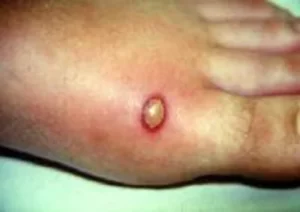
Over the next 3-4 days, the bite site will turn a deep blue, black, or gray color. This is because the tissue there is dying or “necrosing.” Surrounding the dark tissue is a pale ring of skin, which is then surrounded by a reddened area. This forms an iconic “red, white, and blue” pattern.
End
In severe cases, the necrosed skin may ulcerate after about a week and can eventually heal on its own. It’ll make a thick black scab that eventually falls off, sometimes leaving a scar.
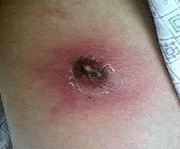
Serious bites may take 1-2 months to fully heal. Applying antibiotic ointment, taking pain relievers like acetaminophen, and keeping the area clean can help.
When to Seek Medical Attention
Typical brown recluse bite symptoms include pain at the site, bruising, swelling, blistering, and aches in the surrounding muscles.
Patients with severe reactions to brown recluse spider bites may exhibit fever, chills, malaise, nausea, vomiting, muscle pain, and joint pain. Someone may become jaundiced and have dark urine. If you’re experiencing these symptoms after a suspected bite, seek medical attention.
Serious reactions are called “systemic loxoscelism.” While this is rare, they typically develop about 24-72 hours after being bit. Sometimes, it can be up to 7 days before a serious reaction sets in.
At-Home Bite Treatment
If you suspect you or someone you know has been bitten:
- Gently clean the site.
- Do not tourniquet the area or pick at the bite.
- Try to identify the spider. Taking a photo, collecting crushed remains, or safely capturing it could be helpful for future diagnosis.
- Monitor for severe reaction symptoms.
Further treatment depends on its severity. Contact your primary care doctor if you experience severe symptoms. There are no medications that explicitly treat brown recluse venom.
Final Thoughts
Brown recluse spiders are guilty of less trouble than they’re blamed for. The likelihood of being bitten by one is low, and most bites can be treated at home. Envenomations may develop serious symptoms. If you or someone you know is experiencing a serious reaction to a suspected brown recluse bite, please contact the Missouri Poison Center or your medical provider.
If you have questions about the brown recluse, call the Missouri Poison Center at 1-800-222-1222. We take calls 24 hours a day, 7 days a week, and are happy to answer any questions you may have.
Referencing content from this page? Please attribute the Missouri Poison Center with either of these links:
https://missouripoisoncenter.org/ or https://missouripoisoncenter.org/the-truth-about-the-brown-recluse-spider/
Suggested APA citation:
Hazelbaker, H.J. (2024, October 8). The truth about the brown recluse spider. Missouri Poison Center. https://missouripoisoncenter.org/the-truth-about-the-brown-recluse-spider/