
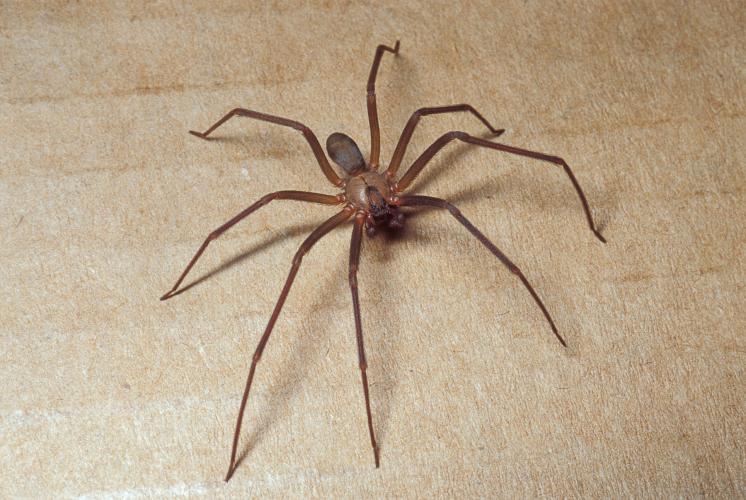
Systemic Loxoscelism (Brown Recluse Spider Envenomation)
The brown recluse spider (Loxosceles reclusa), also known as the violin- or fiddleback spider, is capable of envenomating humans and is endemic to the Midwest and Southeast United States. This spider is found throughout Missouri and prefers dark, warm, dry locations. It commonly inhabits basements, closets, and attics of both rural and urban homes. The brown recluse makes irregular webs, however, it is a nocturnal hunting spider and does not rely on these webs to capture prey.
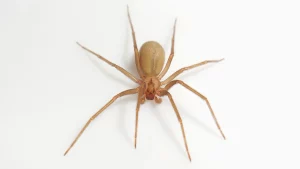
The brown recluse has a distinctive appearance with a light brown body and a brown violin-shaped marking on the dorsum of its cephalothorax (hence the violin- or fiddleback spider name). It is a small spider (6-20 mm) with legs that are much longer than its body and, most characteristic, only 6 eyes set in 3 pairs in a semicircle. Note that many small, brown spiders that appear to have a violin on their back are not brown recluses.
While the brown recluse is best known for envenomation causing necrotic soft tissue effects, some young patients are at risk of developing systemic loxoscelism with fever, leukocytosis, hypotension, profound hemolytic anemia, rhabdomyolysis, acute kidney injury, and potential progression to disseminated intravascular coagulation (DIC) and death if untreated.
Pathophysiology:
Brown recluse venom is cytotoxic and consists of a diverse mixture of enzymes and biologically active compounds. Hyaluronidase facilitates the spread of venom, but the most significant cytotoxic effects are attributed to sphingomyelinase D (phospholipase D). Local necrotic effects occur when sphingomyelinase D initiates an inflammatory cascade, leading to coagulation and vascular occlusion of the microcirculation, resulting in tissue ischemia and skin loss.
The systemic effects of brown recluse bites occur most frequently in patients under 30 years of age. Bites to the head, torso, and proximal extremities appear to pose a higher risk of systemic symptoms. The risk of systemic symptoms does not correlate with the extent of soft tissue necrosis. This syndrome begins 24-72 hours following envenomation and is characterized by non-specific symptoms of immune system activation and hemolysis, rhabdomyolysis, and acute kidney injury. Severity of systemic loxoscelism occurs over a spectrum, and not all findings are reliably present.
The precise mechanism of hemolysis remains unclear. In vitro studies demonstrate that sphingomyelinase D appears to cause hemolysis by both direct activity on erythrocytes and via a complement-dependent pathway. Acute kidney injury is caused by direct renal toxicity of sphingomyelinase D with contribution from circulating free hemoglobin and/or myoglobin in patients with hemolysis or rhabdomyolysis. Thrombocytopenia and mild coagulation abnormalities are commonly reported in systemic loxoscelism, however DIC is a rare manifestation.
Clinical Manifestations:
The initial brown recluse bite frequently goes unnoticed. Bites without a significant venom load result in minimal symptoms or a local urticarial reaction. Within 2-8 hours of significant envenomation, patients experience an early blister or small bruise at the bite site with a surrounding halo of inflammation, often with associated pain. Over the next 3-4 days, these wounds follow a distinctive pattern. Microvascular infarction at the central bite site produces an area of necrosis that is deeply discolored to blue, black, or deep gray, but not red. This violaceous center is surrounded by an ischemic area that is pale in appearance. Surrounding this is a region of inflammation which is mildly erythematous. This forms the classic “red, white, and blue” pattern seen in brown recluse envenomation.
Systemic symptoms of loxoscelism most commonly develop 24-72 hours following a brown recluse bite, though symptoms can be delayed up to 7 days after the bite. Patients experience general inflammatory symptoms of fever, chills, malaise, nausea, vomiting, myalgia, arthralgia, and a diffuse pruritic scarlatiniform rash which may become pustular and desquamate (Acute Generalized Exanthematous Pustulosis – AGEP). They may develop jaundice and the dark urine of hemoglobinuria. Laboratory workup may reveal hemolysis with anemia, rhabdomyolysis, coagulopathy, acute renal injury with elevated creatinine and uremia. Diagnosis is clinical and confirmatory testing is not available.
Loxoscelism Treatment:
Treatment of local dermatonecrosis focuses on local wound care. These wounds necrose and eventually ulcerate over the first week and extensive wounds may take 1-2 months to heal. Patients should be provided analgesic and antipruritic medications as needed and tetanus prophylaxis should be updated or administered if indicated.
Early debridement is not helpful and likely extends the ultimate size of the wound. There is impaired blood flow to the tissue surrounding the central lesion because of damage to the microvasculature. However, much of the apparently-compromised tissue will recover over time if left alone. It may be best to delay intervention as long as possible.
No antidote or directed treatment has shown effectiveness. Specifically, treatment with dapsone is not recommended as it has not demonstrated efficacy and has a significant side effect profile to include methemoglobinemia, hepatitis, and hemolysis. Delayed surgical revision may improve cosmetic outcomes once the wound has healed.
Treatment of systemic loxoscelism is supportive. Patients may require transfusion of blood products and crystalloid fluid resuscitation should be administered to prevent renal injury. Hemoglobin, hematocrit, platelet count, coagulation studies, renal function and urine output should be trended. Infrequently intermittent hemodialysis is initiated for renal failure. In rare cases, prolonged hemolytic anemia refractory to multiple blood transfusions occurs. Therapeutic plasma exchange has been performed with reported resolution of hemolysis.
In the setting of diagnostic ambiguity, patients are often treated for infection with antibiotics. While these do not affect brown recluse envenomation, it may be reasonable because skin infections, especially staph, are frequently misidentified as brown recluse bites.
Conclusion:
The majority of patients with brown recluse envenomation will present with local dermatonecrotic effects. Clinicians should be wary of the potential for infrequent but severe systemic manifestations from brown recluse bites. If you have any questions, please call the Missouri Poison Center at 1-800-222-1222, where specially trained nurses, pharmacists, and medical toxicologists can provide you with the most up-to-date information and management advice on common and uncommon exposures, poisonings and envenomation.
This Poison Alert was developed with contributions from Dr. Frank Dicker.