
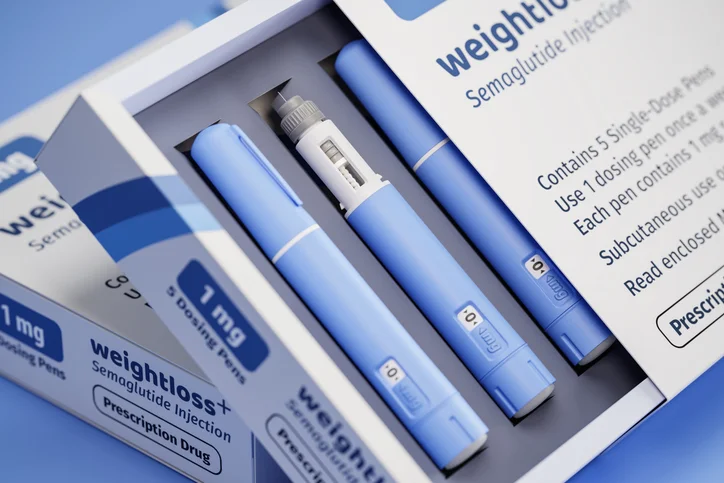
Although the first of many GLP-1 agonists — exenatide, brand Byetta — was approved for type 2 diabetes in 2005, poison centers did not handle many exposure cases until several of these agents were approved for weight loss, and their popularity skyrocketed. In fact, poison centers across the country have seen a nearly 1,500% increase in these calls since 2019.
Sales are expected to continue to soar over the next several years, which will lead to an increase in calls to the poison center about side effects, dosing errors, inadvertent overdose, and unprescribed misuse by naïve individuals.
The GLP-1 Agonist Agents
There are now several drug products in this class, also known as incretin-based therapies (see table below). All are GLP-1 agonists. However, tirzepatide has a dual mode of action, being an agonist for the GIP receptor (Gastric Inhibitory Peptide) as well as for the GLP-1 receptor.
Because they are peptides and are rendered inactive in the stomach, these medications are administered by subcutaneous injection, except for the Rybelsus brand of semaglutide, which is an oral tablet. Rybelsus is formulated with an absorption enhancer to prevent breakdown in the GI tract.
Dosing frequency varies from twice daily to once weekly, depending on the agent. Currently, three of the incretin-based products are FDA approved for weight loss – Wegovy (semaglutide), Saxenda (liraglutide), and Zepbound (tirzepatide). The others are approved for type 2 diabetes only, but several are used off label for obesity such as Ozempic, which has become a buzz word in popular culture.
| GLP-1 Drug | Therapeutic Dose | Time to Peak | Half-Life |
|---|---|---|---|
| Dulaglutide (Trulicity) | Child 10 to 17 yrs: 0.75 or 1.5 mg weekly injection Adult: 0.75 mg to 4.5 mg weekly injection |
1-3 days | 5 days |
| Exenatide IR (Byetta) ER (Bydureon BCise) |
IR: Adult: 5-10 mcg injected BID, 60 min before the 2 main meals ER: Child 10 yrs to Adult: 2 mg weekly injection |
IR: 2 hr ER: Initial release over 8 hr; Peak 7-10 weeks |
IR: 2.5 hr ER: 2-3 weeks |
| Liraglutide (Victoza; Saxenda) |
Child 10 yrs to Adult: 0.6-1.8 mg once daily injection Saxenda for Obesity: Child 12 yrs to Adult: Titrate from 0.6 mg to 3 mg once daily injection. |
11 hr | 13 hr |
| Lixisenatide (Adlyxin) | Adult: 10-20 mcg once daily injection | 1 – 3.5 hr | 3 hr |
| Semaglutide (Ozempic, Wegovy, Rybelsus) |
Ozempic for diabetes; off-label for obesity: Adult: Initially 0.25 mg SQ once weekly for 4 weeks; titrated monthly to 0.5 mg to 2 mg max weekly. Wegovy for obesity: Child 12 yrs to Adult: Initially 0.25 mg SQ once weekly for 4 weeks; scheduled dose increases over 16 weeks to 2.4 mg maintenance dose. Rybelsus for diabetes: Adult: 3 mg PO once daily; titrated monthly to 7 mg or 14 mg max daily. |
Injectables: 1-3 days Oral tablets: 1 hr |
All agents: 7 days |
| Tirzepatide (Mounjaro, Zepbound) | Mounjaro for diabetes, Zepbound for obesity: Adult: Initially 2.5 mg SQ once weekly, titrated monthly to max dose 15 mg weekly injection. |
8-72 hrs | 5 days |
Regulated GLP-1 Alternatives and Counterfeits
Pharmaceutical companies are hard-pressed to keep up with demand, and compounding pharmacies are allowed to fill the void as long as a drug is on FDA’s Drug Shortages list. There is some risk to these products because compounded-but-legal products do not undergo FDA review for safety, effectiveness, or quality before they are sent to market. Although the active ingredient is supposed to be obtained from FDA-approved manufacturing facilities, there have been reports of differences in the active ingredient and formulation components that may affect kinetics and efficacy.
A greater safety concern is the sale of counterfeit medications online. Many of the online sources are profiteering, and their products are unreliable. They may contain the wrong drug, drug in the wrong concentration, or undeclared ingredients, leading to therapeutic failure or unexpected side effects.
Importantly, both compounded and counterfeit products are often dispensed in multi-dose vials with syringes labeled in units or mg rather than mL, which has led to numerous inadvertent overdoses.
Pharmacology & Pharmacokinetics
GLP-1 is a natural gut hormone that enhances glucose-dependent insulin release, suppresses glucagon secretion, slows gastric emptying, and decreases food intake. The GLP-1 agonists mimic these actions, and their modified structures lead to slower elimination and a longer duration of action. While the kinetics vary widely between products (see table above), in general, the onset of side effects may be delayed 12-48 hours after injection.
Adverse Effects from GLP-1 Therapeutic Use, Dosing Errors, & Overdose
GLP-1 agonists often cause gastrointestinal side effects, occurring in up to 50% of patients in some instances. Hypoglycemia is not expected but has been reported, most often in patients who are also using agents known to cause hypoglycemia, such as insulin or sulfonylureas.
Therapeutic Use
Common: Nausea, vomiting, diarrhea, constipation, anorexia, jitteriness, dizziness, headache, dyspepsia, asthenia. Some GI reactions are moderate to severe and induce the patient to quit therapy. Nausea usually lessens over several weeks of therapy.
Rare: Hypersensitivity reactions (rash, pruritus, dyspnea), acute kidney injury, acute pancreatitis, gallbladder disease, hypoglycemia, ECG changes, and tachycardia.
Dosing Errors & Overdose
Most cases at the Missouri Poison Center involve patients taking the wrong dose, administering more frequently than recommended, taking someone else’s medication, errors with the injectable pens, or making an error with the measurements of the syringe of a compounded or counterfeit product.
Dosing errors and overdose can lead to significant nausea and vomiting that may be prolonged over several days. In some cases, hospitalization was required, although most have responded to outpatient management with antiemetic and prokinetic agents.
Treatment
Treatment is symptomatic and supportive, there is no antidote. Most often, decreasing the dose or pausing therapy will improve minor-to-moderate gastrointestinal symptoms. In some cases, IV fluids, antiemetics, and a prokinetic agent such as metoclopramide are needed. Other rare side effects such as pancreatitis, gallbladder issues, and nutritional defects should be evaluated and treated accordingly.
Maintain contact with the Missouri Poison Center to take advantage of our experience with GLP-1 agonists. Our specially trained nurses, pharmacists, and toxicologist can provide the most up-to-date information regarding exposures and treatment. For patient-specific guidance, please contact the poison center’s dedicated line for healthcare professionals at 1-888-268-4195.