
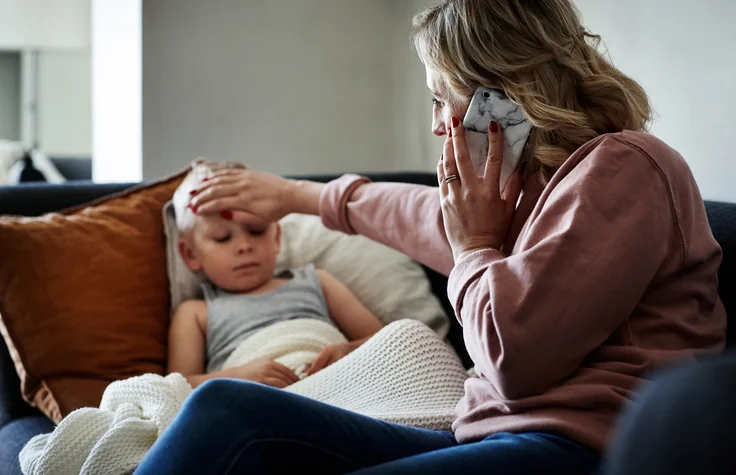
When facing a potential poisoning situation, you have two options: call the Missouri Poison Center or look up what to do online. Nowadays, online searches often provide the option to query using artificial intelligence (AI). Large Language Models (or LLMs) help process those searches into content we can understand.
But which source is more trustworthy: humans or AI? Which is more convenient while still being accurate? Today we’re stating the facts on why it’s best to call the Missouri Poison Center in the presence of a potential poisoning.
Is the information from AI searches accurate?
If you’ve ever asked a health-related question to an AI (like Claude, ChatGPT, Grok, or Google Gemini), you may have seen a disclaimer attached to the end of its answer: “This is not medical advice.” This disclaimer keeps the AI companies legally safe from consequences associated with mistakes the AI may make. This is because the AI is not a healthcare provider, whereas the Missouri Poison Center is staffed by registered nurses and pharmacists with physician oversight.
In a recent study, researchers found that although some AI systems could accurately diagnose “textbook” medical conditions, the LLMs fell short when it came to responding to patient queries, only giving accurate courses of action to patients less than half of the time.
Let’s take a look at a recent inaccuracy involving AI and one of the Missouri Poison Center’s blogs.
Case Study: Thyroid Medication
In October 2026, Google’s AI Overview gave an inaccurate recommendation when asked the query, “What if I accidentally take two thyroid pills?” The Missouri Poison Center’s blog on thyroid medicine was referenced throughout the answer.
The AI advised the reader to skip their next dose of medicine, citing the Missouri Poison Center specifically. However, our article never says to skip a dose. Instead, we recommend contacting a healthcare provider if you miss a dose or take two doses. Please refer to the blog for more information.
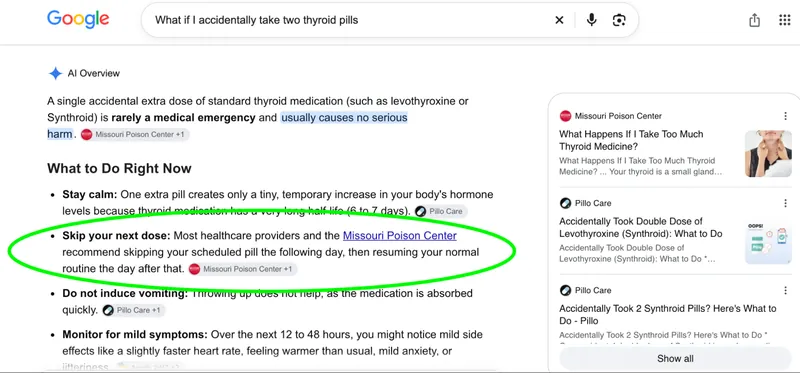
If someone with hypothyroidism followed these instructions, they could end up missing a day of medication when they shouldn’t. It depends on the situation. There is important medical information provided that should be discussed with a healthcare provider. Google’s answer to this question has since changed, which shows how much an AI answer may vary from one day to the next.
Poison emergencies are rarely one-size-fits-all. Before offering advice, a trained poison expert carefully evaluates a person’s medical history and the details of the situation. When someone calls the Missouri Poison Center, specialists gather key information such as age, health history, timing of the exposure, and the amount involved. This allows healthcare professionals to provide informed, reliable guidance based on the individual’s specific circumstances. By comparison, AI-generated information often comes with a warning that mistakes are possible.
AI Searches Are Not Always Updated
When you type in a query, AI is not searching the entire internet for your answer. Instead, it is often pulling from information on which the model was trained. This is similar to when someone asks you a question you know the answer to, such as, “What is two plus two?” You wouldn’t go look up the answer— which takes time and energy— but rather you’d rely on your memory and previous schooling. The same rules apply for artificial intelligence.
Therefore, if a large language model’s training ended in 2024, for example, the information it relies on most of the time comes from 2024 or before. So if there has been a major update in the health industry, it may not retrieve that information unless you are asking for it specifically.
Only 34% of ChatGPT queries require it to search the internet for answers according to a recent study. This means that about two-thirds of the time, an AI’s answer is not refreshed with new information from the live internet.
When you call the Missouri Poison Center, you are provided with the most up-to-date information. This is because the poison center healthcare professionals are specifically trained and held to high standards of accuracy and patient safety. Not only the public, but physicians and other healthcare professionals will use the Missouri Poison Center as a resource for current information on toxicity treatments and assessment.
The Missouri Poison Center Is Confidential— AI Is Not
Privacy is a top priority at the Missouri Poison Center. Any personal information you share during a call is kept confidential and protected. While information about the exposure may be documented, such as the substance involved, the patient’s age, and other relevant details, this information is not linked to personally identifying information when used for reporting, quality improvement, research, or poison prevention activities.
As a healthcare provider, the Missouri Poison Center follows the requirements of the Health Insurance Portability and Accountability Act (HIPAA) to help ensure the privacy and security of your health information.
Although it may feel private, a conversation with an AI is not confidential. LLMs may send conversations back to third parties for training. This means that the information you share in a conversation could potentially be shown to another person. Additionally, personal information from LLM conversations may be summoned in legal cases. Your privacy is not guaranteed with AI.
Is it free to call the Missouri Poison Center?
Yes, every call to the Missouri Poison Center is free. There does not need to be an emergency to use the Poison Help line— you can ask poison-related questions any time of the day, every day of the year. There’s no limit to the number of questions you may ask.
It should be noted that it’s also free to use some services of OpenAI, Gemini, or Claude. The difference is that the advice isn’t always accurate, private, or up to date. Artificial intelligence has great potential to help bridge the gap between the medical office and the patient, but we haven’t arrived there yet. For now, it’s best to rely on human expertise.
Many common poisonings may be taken care of at home if the right steps are followed. Call the Missouri Poison Center at any time, any day of the year, when you have poison-related questions. Our number is 1-800-222-1222.
Frequently Asked Questions
No. Some serious poisonings do not cause symptoms right away. If you suspect someone swallowed, inhaled, or came into contact with something harmful, call the Missouri Poison Center at 1-800-222-1222 right away, even if they feel fine. Don’t delay the call to search online or wait for an AI response.
Call 911 immediately if the person collapses, has a seizure, has trouble breathing, or cannot be awakened. These warning signs require emergency help rather than an online search or chatbot conversation. For suspected poisonings without these life-threatening symptoms, call the Missouri Poison Center for guidance.
No. Do not make someone vomit or try a home remedy if you think they may have been poisoned. Treatments that seem helpful, including remedies shared online, can sometimes make the situation worse or delay the right care.
The safest response depends on what happened, how much was involved, the person’s age, and their symptoms. Instead of following general “detox” advice, call the Missouri Poison Center for advice specific to your situation before trying any treatment.
Learn more about outdated poisoning remedies and why they are no longer recommended in our blog article: Outdated Poison Treatments.
Referencing content from this page? Please attribute the Missouri Poison Center with either of these links:
https://missouripoisoncenter.org/ or https://missouripoisoncenter.org/artificial-intelligence/
Suggested APA citation:
Hazelbaker, H.J. (2026, November 17). Is it better to use AI or the Missouri Poison Center? Missouri Poison Center. https://missouripoisoncenter.org/artificial-intelligence/